How Commercial Kitchens Differ from Residential Kitchens
By paramount
A kitchen designed for a family and one designed to serve hundreds of customers may share familiar elements such as ovens, refrigerators, worktops, and cooking areas, but their requirements are fundamentally different. A residential kitchen is built around convenience, comfort, and occasional meal preparation, whereas a commercial kitchen is engineered for continuous production, efficiency, safety, and high-volume operations.
Understanding these differences is essential when planning a restaurant, hotel, bakery, catering facility, or any other food service operation. The right layout, equipment, ventilation, storage, and workflow to ensure an efficient and well-functioning kitchen.
What Is a Residential Kitchen?
A residential kitchen is designed for everyday household cooking. Its primary purpose is to provide a comfortable and practical space where individuals or families can prepare meals, store ingredients, and clean up afterward.
Since the volume of food is relatively low, residential kitchens generally use standard-sized appliances and require less storage and preparation space. The layout is often designed around convenience and aesthetics, with features such as cabinets, kitchen islands, domestic refrigerators, built-in ovens, and compact worktops. The workflow is also flexible. In a residential kitchen a single person may handle preparation, cooking, serving, and cleaning without needing separate workstations or specialized systems. Since the kitchen is not expected to operate continuously, domestic equipment is usually sufficient for its intended purpose.
What Is a Commercial Kitchen?
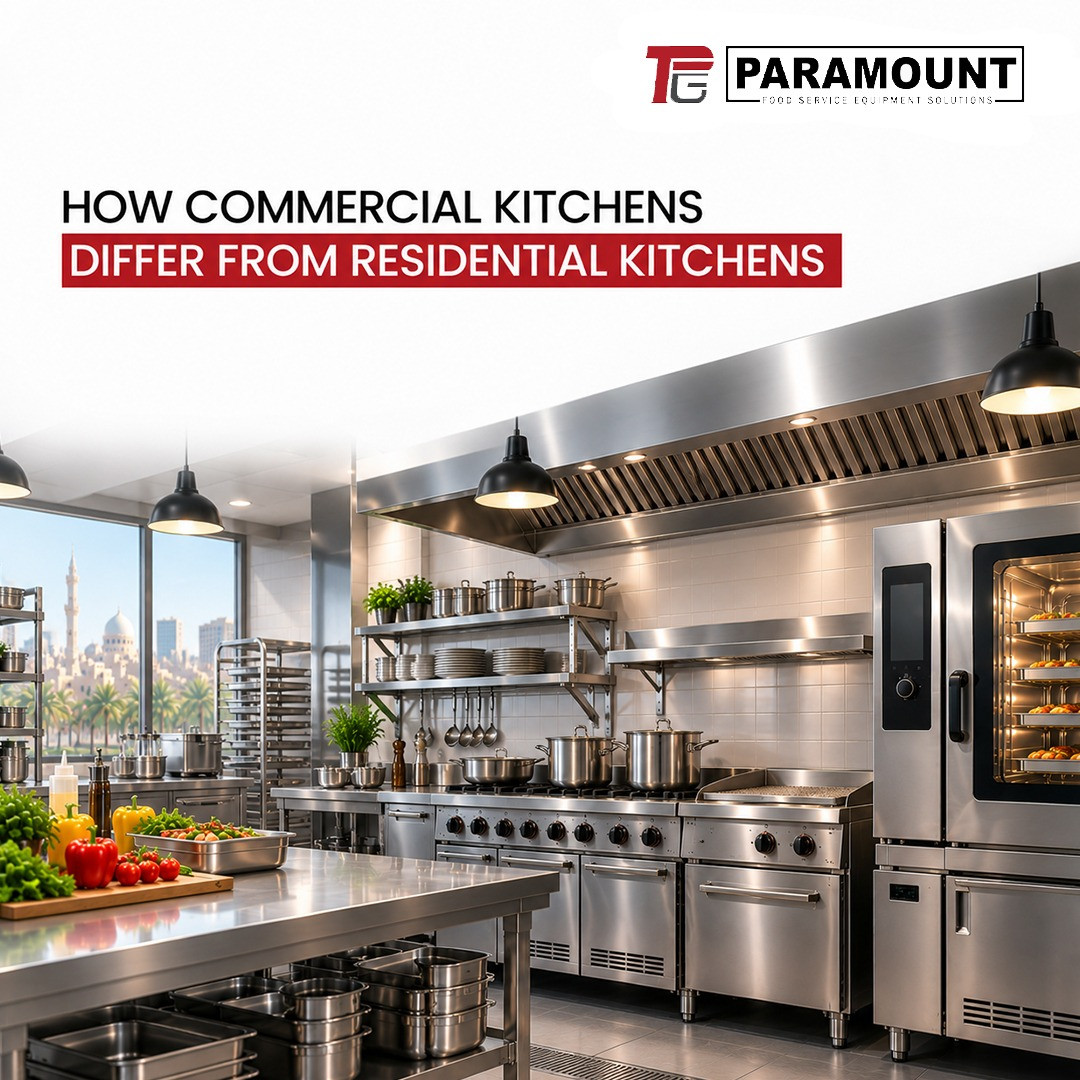
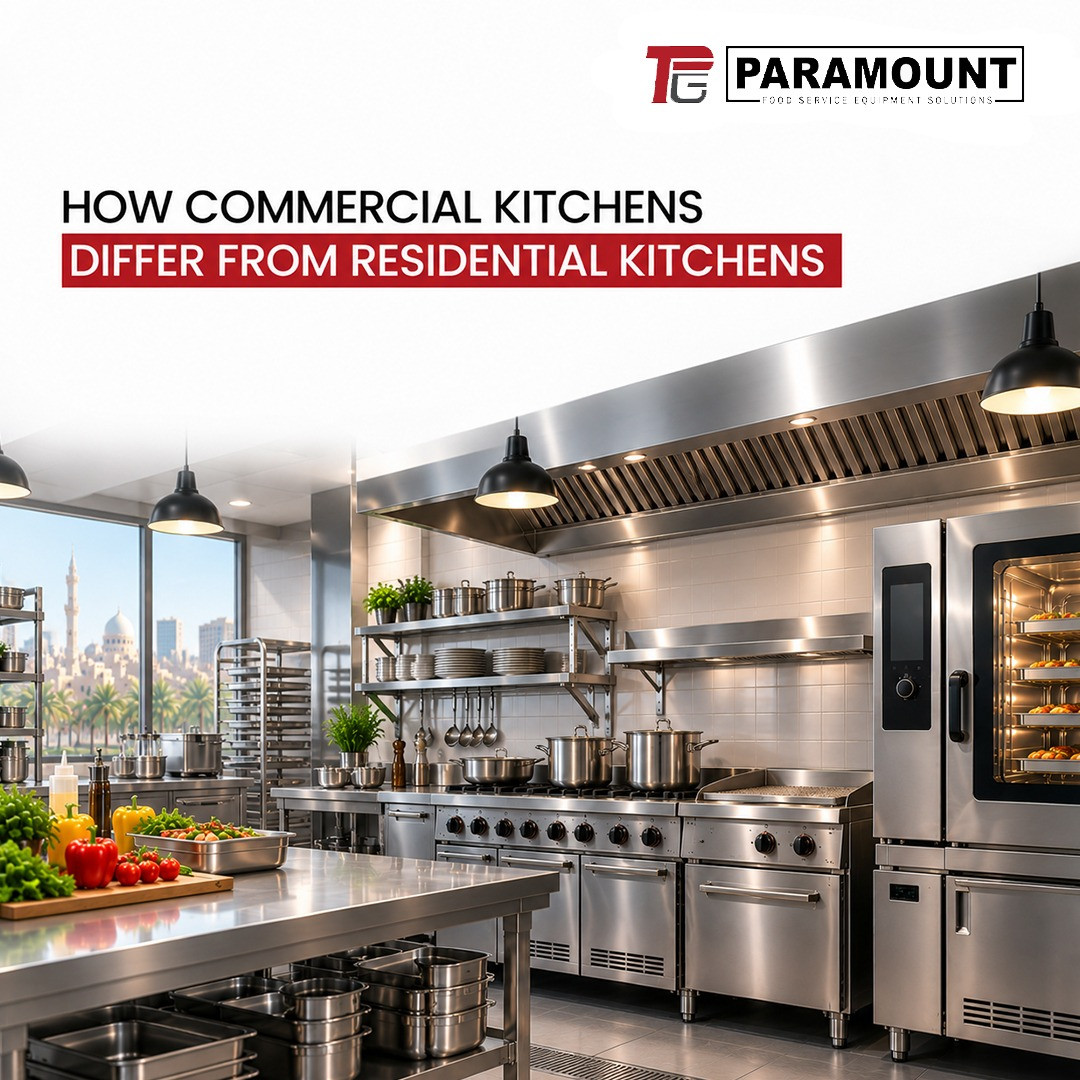
A commercial kitchen is a professional food production environment designed to prepare, cook, store, and serve food at a much larger scale. It can be found in restaurants, hotels, hospitals, bakeries, cafeterias, catering businesses, and other food service establishments. Unlike a residential kitchen, every part of a commercial kitchen is planned around operational efficiency. The layout determines how ingredients move from storage to preparation, cooking, plating, and service. Equipment is selected based on capacity, frequency of use, output, durability, and the type of food being produced.
Commercial kitchens also need to accommodate multiple staff members working simultaneously. This makes space planning, workstation positioning, ventilation, hygiene systems, and safety considerations essential parts of the overall design.
Key Differences Between Commercial and Residential Kitchens
The differences become clearer when both kitchen types are compared based on how they are designed and operated.
Scale of Operations
The most fundamental difference is the amount of food each kitchen is expected to handle. A residential kitchen generally prepares a few meals at a time, while a commercial kitchen may need to produce hundreds of portions during a single service. This difference affects everything from cooking equipment and refrigerator capacity to preparation areas and storage. Commercial operations need equipment and infrastructure capable of handling large quantities without slowing down production.
Equipment and Technology
Residential kitchens typically rely on domestic appliances designed for intermittent use. Commercial kitchens require heavy-duty equipment that can withstand frequent and continuous operation. Commercial equipment can include combi ovens, convection ovens, commercial fryers, griddles, grills, planetary mixers, food processors, blast chillers, cold storage systems, and high-capacity dishwashing equipment. These appliances are designed to improve production capacity, consistency, and efficiency.
When conducting a kitchen equipment comparison, businesses need to consider more than the size of an appliance. Capacity, energy consumption, durability, maintenance, safety features, and compatibility with the kitchen’s workflow are equally important.
Layout and Design
Kitchen design is another major distinction. Residential kitchens are often designed around personal comfort and visual appeal, while commercial kitchens are designed around workflow.
A professional kitchen needs enough space for employees to move between stations without creating congestion. Storage, preparation, cooking, plating, washing, and service areas are positioned strategically to reduce unnecessary movement. The layout may also be organized into dedicated stations such as preparation, cooking, pastry, cold food, washing, and dispatch. A well-planned layout can improve productivity while reducing accidents and operational delays.
Workflow and Movement
In a residential kitchen, the cook can move between different tasks whenever necessary. Commercial kitchens require a much more controlled flow.
Ingredients typically move from receiving and storage to preparation, cooking, plating, and finally service. Keeping these stages organized helps prevent unnecessary movement and reduces the possibility of cross-contamination. The objective is to create a smooth workflow in which staff, ingredients, equipment, and finished dishes can move efficiently through the kitchen.
Storage Capacity
Storage requirements increase significantly with commercial operations. Residential kitchens generally need enough space for household groceries and basic cooking supplies. Commercial kitchens need separate areas for dry ingredients, refrigerated products, frozen food, cooking supplies, utensils, packaging materials, and cleaning products. Refrigeration capacity also needs to match the volume and type of ingredients being stored.
Proper storage planning helps businesses maintain food quality, improve inventory control, and make frequently used ingredients easily accessible.
Speed and Performance
A residential kitchen does not normally operate against strict service deadlines. Commercial kitchens do. During busy periods, several orders may need to be prepared simultaneously within a limited timeframe.
This makes equipment performance particularly important. Commercial ovens need to maintain consistent temperatures, refrigeration systems need reliable cooling, and cooking equipment needs to recover quickly between batches. The overall kitchen must therefore be capable of maintaining performance even during peak operating hours.
Hygiene and Food Safety
Both kitchen types require cleanliness, but commercial kitchens operate under significantly more structured hygiene and food safety requirements.
Professional kitchens need appropriate food storage systems, temperature control, sanitation procedures, waste management, handwashing facilities, and cleaning schedules. Equipment and surfaces are also selected with regular cleaning and sanitation in mind. Understanding commercial kitchen requirements is particularly important during the planning stage because factors such as food safety, ventilation, drainage, waste disposal, and fire safety can influence the design and equipment selection.
Ventilation and Exhaust Systems
Ventilation is often one of the most overlooked differences between residential and commercial kitchens. A home kitchen may use a relatively compact exhaust hood designed for occasional cooking.
Commercial kitchens generate substantially more heat, smoke, grease, steam, and cooking fumes. They therefore require professionally designed ventilation and exhaust systems capable of maintaining air quality and controlling heat. The ventilation system needs to work alongside cooking equipment and the overall kitchen layout rather than being treated as an afterthought.
Safety and Workplace Requirements
Residential kitchens are generally used by a small number of people. Commercial kitchens may have several employees working around hot surfaces, sharp equipment, electrical appliances, gas systems, and wet floors at the same time.
Consequently, professional kitchens need greater attention to fire safety, equipment placement, electrical systems, gas connections, flooring, emergency access, and staff movement. Safety considerations should be incorporated into the design from the beginning rather than added after the kitchen is installed.
Cleaning and Maintenance
Commercial equipment experiences significantly more wear because of frequent use. As a result, accessibility for cleaning and maintenance becomes an important part of kitchen planning. Equipment should be positioned so that staff can clean surrounding areas effectively, while drainage, waste handling, and washing facilities need to support regular high-volume operations. Choosing durable equipment and planning for routine maintenance can also help reduce unexpected downtime and replacement costs. Working with experienced kitchen equipment suppliers in Abu Dhabi can also help businesses select commercial kitchen equipment that meets the required safety standards and is suitable for efficient cleaning, maintenance, and long-term use.
Choosing the Right Kitchen for the Operation
A residential kitchen and a commercial kitchen are designed for fundamentally different purposes. A home kitchen prioritizes comfort and convenience, while a commercial kitchen prioritizes productivity, capacity, safety, hygiene, and consistency. For anyone planning a restaurant or other food service operation, selecting equipment should therefore begin with understanding the operation itself. The expected number of customers, menu, production volume, available space, staffing, storage requirements, and service style all influence the ideal kitchen design. When sourcing commercial kitchen equipment in Dubai, businesses should consider these factors carefully to ensure that every piece of equipment suits the kitchen’s operational needs, available space, and expected workload.
Whether you are setting up a new food business or upgrading an existing facility, understanding these differences can help you make more confident decisions about kitchen design and equipment. Partnering with Paramount for your commercial kitchen equipment needs can help you choose the right equipment based on your kitchen’s layout, operational requirements, safety standards, and maintenance needs. With the right professional equipment in place, you can improve productivity, support food safety, reduce operational bottlenecks, and create a more efficient working environment.